


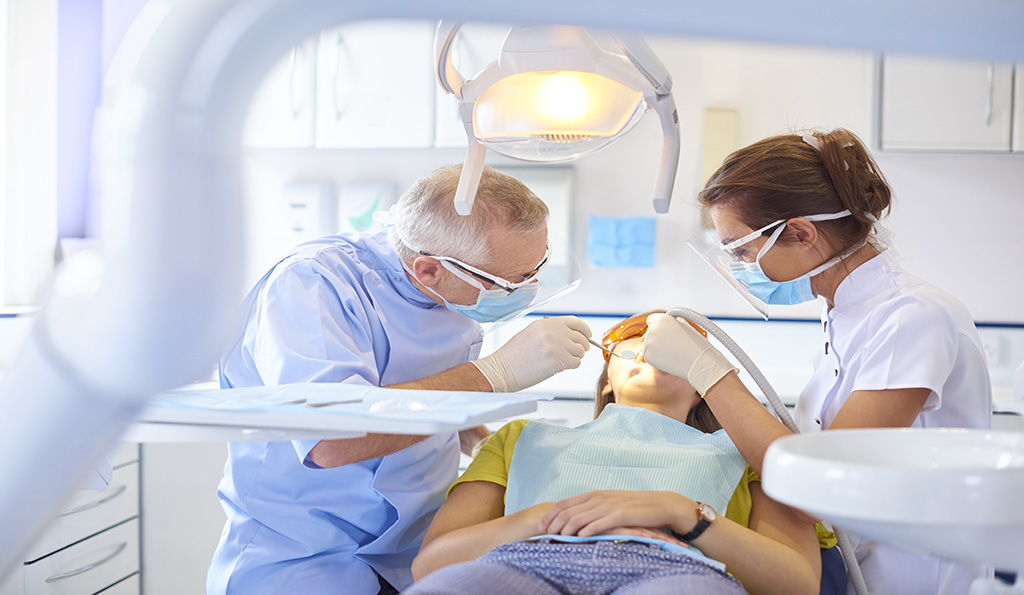
On March 16, 2020, the American Dental Association (ADA) recommended that dentists suspend all non-essential procedures and limit care to urgent and emergency dental treatments during the COVID-19 outbreak.
OSHA advises that emergency dental care for suspected or confirmed COVID-19 patients should only occur if adequate PPE and precautions are available.
Dental employers should:
-
Monitor updates on virus spread and testing availability
-
Follow phased guidelines under Opening Up America Again
-
Adjust protocols based on evolving local, state, or federal health guidance
Exposure Risk Levels in Dental Work
OSHA classifies dental work into four exposure risk categories:
| Risk Level | Examples |
|---|---|
| Lower (Caution) | Administrative duties in non-public areas |
| Medium | Non-aerosol emergency care for healthy patients; busy shared staff areas |
| High | Emergency care for suspected/confirmed COVID-19 cases (non-aerosol procedures) |
| Very High | Aerosol-generating procedures on suspected/confirmed COVID-19 patients |
Refer to OSHA’s Risk Pyramid for further classification.
Infection Prevention Protocols
Until more is understood about COVID-19 transmission, OSHA recommends a layered approach for dental care:
For Non-Aerosol Procedures on Healthy Patients:
-
Standard, contact, and droplet precautions
-
Eye protection (goggles or face shield)
For Suspected/Confirmed COVID-19 Cases or Aerosol-Generating Procedures:
-
Airborne precautions
-
NIOSH-approved respirators (e.g., N95, R95, or PAPR)
-
Full PPE ensembles per OSHA standards
Aerosol-generating devices include dental turbines, micro-motor handpieces, ultrasonic scalers, and air-water syringes.
For current clinical control recommendations, refer to CDC guidance.
How OSHA and CDC Guidelines Compare
CDC and OSHA guidance may appear different, but both aim to:
-
Support workplace safety
-
Ensure compliance with federal standards, including:
-
Bloodborne Pathogens (29 CFR 1910.1030)
-
Respiratory Protection (29 CFR 1910.134)
-
PPE Standards (29 CFR 1910 Subpart I)
-
Employers must also consider OSHA enforcement flexibilities regarding PPE shortages and respirator use.
Hierarchy of Controls for COVID-19 in Dentistry
1. Elimination
Limit services to only urgent or emergency procedures to reduce exposure risks. Elective dental care should be postponed.
2. Engineering Controls
-
Use physical barriers between patient areas
-
Implement local exhaust ventilation where possible
-
Maintain directional airflow to move air away from patients and toward staff areas
3. Administrative Controls
-
Screen patients via phone triage or teledentistry
-
Isolate symptomatic individuals immediately
-
Limit staff exposure during aerosol-generating procedures
-
Avoid unnecessary personnel in treatment rooms
4. Safe Work Practices
-
Use high-volume suction and dental dams to reduce aerosols
-
Minimize use of ultrasonic scalers and air-water syringes
-
Avoid patient-side tasks like charting or sterilization
-
Follow strict hand hygiene and face-touching avoidance
Train and retrain staff regularly on updated protocols.
Personal Protective Equipment (PPE)
| Patient Type | Procedure Type | Recommended PPE |
|---|---|---|
| Healthy Patient | Non-aerosol | Scrubs or gown, gloves, eye protection, surgical mask |
| Healthy Patient | Aerosol | Gown, gloves, eye protection, N95 respirator |
| COVID-19 Suspected/Confirmed | Any | Gown, gloves, eye protection, N95 or higher |
| COVID-19 Suspected/Confirmed | Aerosol | Gown, gloves, eye protection, R95, P95, elastomeric, or PAPR |
Important: PPE should be part of a complete Respiratory Protection Program including medical evaluation, fit testing, and training.
Cleaning and Disinfection
-
Use EPA-registered, hospital-grade disinfectants (see List N)
-
Clean all surfaces before applying disinfectant
-
Sterilize equipment per CDC’s 2008 Disinfection Guidelines
-
Use HEPA filters or equivalent in vacuum lines
-
Train staff on handling both chemical disinfectants and infectious materials
Key OSHA Regulations Relevant to Dentistry:
-
Bloodborne Pathogens Standard (29 CFR 1910.1030)
-
Respiratory Protection Standard (29 CFR 1910.134)
-
PPE Requirements (29 CFR 1910 Subpart I)
More info: OSHA’s Dentistry Safety Page
Additional Resources:
-
OSHA COVID-19 Dentistry Guidance